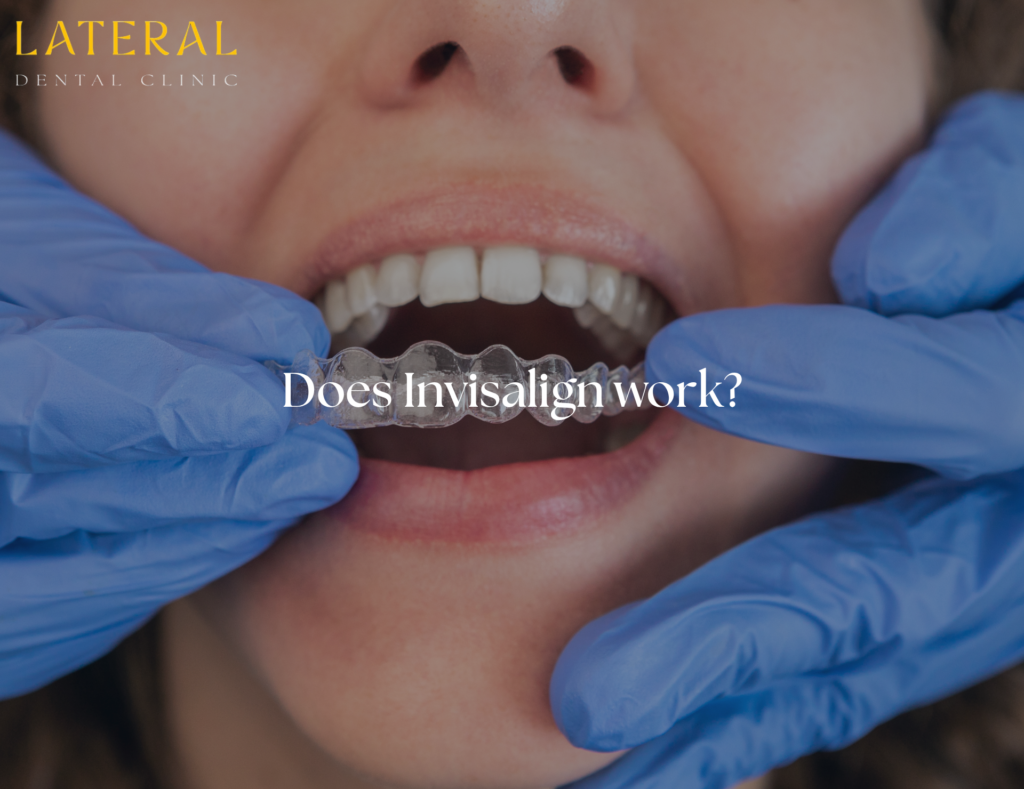
Does Invisalign work?
Let's answer this common question together
The question comes up regularly and it deserves a direct answer rather than an enthusiastic sales pitch dressed up as information.
Does Invisalign work? Yes, for the majority of orthodontic presentations, and with a clinical evidence base that has grown substantially over the two decades since the system launched. The more useful follow-up questions are: does it work for your specific case, what does compliance with treatment actually require, and what distinguishes good results from average ones?
At Lateral Dental Clinic in Sheffield, led by Dr Matthew Stephens GDC No. 263989 and Dr Anupa Stephens GDC No. 264031, Invisalign treatment in Sheffield is one of the most frequently requested treatments we provide. Here is the complete, honest clinical picture.
The direct answer: what Invisalign can and cannot treat effectively
Does Invisalign work for all orthodontic problems equally? No, and being clear about this is more useful than a blanket reassurance.
Invisalign works very well for:
- Mild to moderate crowding. Crowded teeth, where there is insufficient space in the arch for all the teeth to sit in their optimal positions, is the most common presentation that Invisalign addresses. For mild crowding (up to approximately 4mm of discrepancy) and moderate crowding (4 to 9mm), Invisalign consistently produces excellent results.
- Spacing and gaps. Gaps between teeth, whether a central diastema (the gap between the upper front teeth) or multiple spacing issues across the arch, are closed effectively with aligner therapy. The digital planning allows precise control over how the space is distributed and closed.
- Dental overbite. A deep bite (where the upper front teeth excessively cover the lower front teeth vertically) responds well to Invisalign for most dental presentations, through a combination of incisor intrusion and posterior extrusion managed via precision bite ramps built into the aligner material.
- Overjet. Increased horizontal distance between the upper and lower front teeth (commonly called “protruding teeth” in everyday language) is managed through a combination of arch coordination and specific tooth movements.
- Mild to moderate crossbite. A crossbite occurs when some upper teeth sit inside the lower teeth when biting. Both anterior and posterior crossbites respond to aligner therapy, though posterior crossbites of significant extent may require additional appliances alongside the aligners.
- Open bite. An anterior open bite, where the front teeth do not make contact when the back teeth are together, is one of the presentations where clear aligner therapy has a distinct clinical advantage over fixed braces for many patients: the aligner material creates a posterior bite platform that depresses the back teeth while the front teeth close.
Invisalign works less effectively for:
- Very severe crowding. Cases requiring more than 10mm of arch development, or those needing significant tooth extraction and complex retraction mechanics, are better managed with fixed appliances or a combination approach.
- Significant skeletal discrepancies. Where the problem is in the jaw bones rather than the teeth, Invisalign can provide dental compensation (moving the teeth to camouflage the skeletal difference), but it cannot move the bones themselves. Severe skeletal discrepancies require either orthognathic surgery or acceptance of the limitations of dental compensation.
- Severe vertical problems. Extruding (bringing forward) teeth that are severely over-erupted or that need significant vertical repositioning is biomechanically more challenging for clear aligners than for fixed appliances.
- Complex individual tooth movements. Significant root torquing (controlling the angulation of the root, not just the visible crown) in complex cases is technically more demanding with aligners, though the current generation of Invisalign attachments has significantly improved capability in this area.
How Invisalign actually works: the mechanism
Understanding the mechanism behind aligner therapy explains both its effectiveness and its limitations.
Each aligner in the Invisalign series is manufactured to a slightly different shape from the current tooth positions. When placed, it applies controlled forces to specific teeth through the elastic deformation of the polyurethane material. These forces cause the teeth to move toward the planned position through the same biological mechanism as all orthodontic tooth movement: the pressure on one side of the tooth root signals the bone to resorb, and the tension on the other side signals the bone to deposit. The tooth moves through the bone, following the gradient created by the aligner.
Each aligner is worn for approximately one to two weeks (depending on the treating clinician’s protocol) before being replaced with the next in the series, which is manufactured slightly closer to the target position. The cumulative effect of these incremental changes, over the full aligner series, produces the planned tooth movement.
What makes Invisalign different from older clear aligner systems is the digital planning precision and the AI-assisted treatment planning that allows the clinician to visualise and adjust every step of the tooth movement before any aligner is manufactured. This predictive capability is one of the primary reasons Invisalign consistently outperforms generic clear aligner systems in controlled studies.
The role of attachments in Invisalign effectiveness
A significant component of how well Invisalign works for more complex movements is the attachment system.
Attachments are small, tooth-coloured composite resin shapes bonded to the surface of specific teeth. They provide anchorage points that allow the aligner to exert force in directions that the aligner material alone cannot achieve: rotation of cylindrical teeth (canines, premolars), extrusion, torquing of roots, and controlled tipping. The attachments are planned digitally as part of the overall treatment plan and are placed at the beginning of treatment.
The shape, size and orientation of each attachment is calculated to produce the specific force vector needed for the planned movement. A clinician who understands attachment design and knows when and how to use them produces measurably better outcomes than one who follows a default plan without modification.
The current generation of Invisalign uses SmartForce attachments and SmartTrack material, which has significantly better elastic properties than earlier aligner materials, producing more consistent force delivery throughout each aligner’s wearing period.
Compliance: the single most important variable after case selection
Does Invisalign work if it is not worn consistently? The honest answer is: much less well, and in some cases not at all.
Invisalign aligners must be worn for a minimum of 20 to 22 hours per day to produce the forces needed for effective tooth movement. This means they are removed only for eating, drinking anything other than water, and oral hygiene. At all other times, including during sleep, they must be in position.
The clinical implications of poor compliance are specific and predictable. Each aligner is designed to move the teeth by a small, planned increment before the next aligner is placed. If the teeth have not moved far enough because the aligner was not worn sufficiently, the next aligner will not fit well. Sequential fit degradation progressively undermines the treatment plan. By the end of a 30-aligner series where compliance has been poor, the actual tooth position may be significantly different from the planned position.
This is why clinical monitoring matters. At Invisalign appointments at Lateral Dental Clinic, the fit of the current aligner and the progress of tooth movement relative to the plan are assessed at each review. Where movement is tracking behind the plan, the treatment team can intervene: refinements (additional aligner series manufactured from the current tooth position), auxiliary mechanics, or adjustments to the wearing protocol.
Does the clinician's experience make a difference?
Yes, significantly.
Invisalign provides software and aligner manufacturing capability. What the software produces is a starting point, not a finished treatment plan. Experienced clinicians consistently modify the digital plan: adjusting staging sequences, modifying attachment design, prescribing auxiliary elastics where needed, and identifying which cases require features of the plan to be changed before the aligners are manufactured.
The difference between a treatment plan submitted exactly as the AI system generates it and one that has been reviewed and modified by a clinician with deep aligner experience is substantial. This is why the same Invisalign system, treating similar cases, produces different outcomes in different clinical environments.
Dr Matthew Stephens and Dr Anupa Stephens bring specific expertise in Invisalign treatment at Lateral Dental Clinic, which includes reviewing and optimising treatment plans, monitoring movements at each appointment, and intervening promptly when the treatment is not tracking as expected.
What the clinical evidence shows
The question does Invisalign work has been addressed in the peer-reviewed literature, and the evidence is now sufficiently substantial to draw clear conclusions.
Systematic reviews comparing clear aligner therapy to fixed appliances for specific tooth movements consistently show:
Invisalign produces equivalent or superior outcomes for expansion of the dental arch, alignment of mild to moderate crowding, and closure of spacing. It shows comparable outcomes to fixed appliances for most routine cases when worn as directed.
For more complex movements (significant extrusion, severe rotations of cylindrical teeth, precise root torquing), fixed appliances retain a biomechanical advantage, though the gap has narrowed considerably with the current generation of SmartForce attachments and SmartTrack material.
Patient-reported outcomes consistently favour clear aligners for comfort and quality of life during treatment compared to fixed appliances. Patients report fewer dietary restrictions, easier oral hygiene maintenance, less speech disruption after initial adaptation, and significantly fewer emergency appointments for broken brackets or poking wires.
How long does Invisalign treatment take?
Treatment duration varies considerably based on case complexity and patient compliance, but some reference points are useful:
- Mild cases (minor crowding, small gaps, slight overbite): typically 3 to 6 months with Invisalign Lite, which covers up to 14 or 20 aligners depending on the package.
- Moderate cases: typically 9 to 18 months.
- Complex comprehensive cases: 18 to 30 months, sometimes longer.
These are estimates based on the planned treatment. Actual duration is influenced by compliance (wearing the aligners as directed accelerates progress) and biological response to tooth movement (which varies between patients and cannot be predicted with complete precision at the outset).
Refinements, where additional aligners are manufactured after the initial series to fine-tune the final tooth positions, are a normal part of comprehensive Invisalign treatment and should be budgeted for in the overall timeline.
After Invisalign: retention and maintaining the result
Does Invisalign work in the long term? Only with proper retention.
Teeth that have been orthodontically moved will relapse toward their original positions if not held in place. The periodontal ligament fibres, which are remodelled during treatment as the teeth move, take considerable time to reorganise in the new position. Without a retainer, the elastic recoil of these fibres begins to move the teeth back almost immediately.
Retention after Invisalign involves either a removable retainer (typically Vivera retainers, the Invisalign proprietary retention system, worn nightly) or a fixed bonded retainer on the back of the front teeth, or a combination of both. Retention is not a temporary phase: it is a permanent commitment. Patients who wear their retainers consistently maintain their results indefinitely.
In conclusion
Does Invisalign work? Yes, for the majority of cases presenting for orthodontic treatment, and with a clinical evidence base that supports its effectiveness for alignment, spacing, overbite and crossbite correction. It works less well at the extremes of complexity, where skeletal surgery or fixed appliances are the more appropriate treatment choice.
What makes the difference between a result that exceeds expectations and one that falls short is: case selection, the quality of the digital treatment plan, compliance with wearing the aligners, consistent clinical monitoring, and the retention phase that follows treatment.
At Lateral Dental Clinic in Sheffield, Invisalign treatment is delivered with the clinical attention to planning and monitoring that determines whether the technology delivers on its promise.
Disclaimer
The information in this article is intended for general educational guidance only and does not constitute personalised dental or orthodontic advice. Suitability for Invisalign treatment depends on individual clinical assessment by a qualified dental professional.
Lateral Dental Clinic is a private dental practice in Sheffield, led by Dr Matthew Stephens GDC No. 263989 and Dr Anupa Stephens GDC No. 264031. We offer Invisalign in Sheffield, composite bonding, porcelain veneers, teeth whitening, dental crowns, smile makeovers, dental sedation and general dentistry.
Frequently asked questions
For mild to moderate crowding, spacing, overbite correction and many routine alignment cases, Invisalign produces outcomes that are clinically equivalent to fixed braces. For complex movements including significant root torquing, severe rotation of cylindrical teeth, and large vertical corrections, fixed appliances retain a biomechanical advantage. The right choice depends on the specific case, the patient’s lifestyle priorities, and the treating clinician’s experience with both systems.
Less effectively, and sometimes not at all. The 20 to 22 hour daily wearing requirement is the minimum for effective tooth movement at the rate the treatment is designed for. Wearing aligners for 18 hours per day means six hours of no force being applied each day, which significantly reduces the cumulative force and the rate of movement. Over a full treatment course, this consistently leads to the actual tooth positions diverging from the planned positions, requiring additional refinement aligners. Wearing aligners for 22 hours per day produces faster, more predictable movement than the planned schedule in many cases.
The most common reasons are: poor compliance (not wearing the aligners for the required hours), a treatment plan that was not adequately optimised for the case complexity, or a biological response to tooth movement that is slower than average. Poor aligner fit at any stage (where the aligner does not seat fully against the teeth) indicates the teeth have not tracked with the plan and needs clinical assessment. Cases that are more complex than initially assessed also produce less predictable results if the limitations are not identified early. Regular monitoring appointments at Lateral Dental Clinic allow these issues to be identified and corrected promptly.
Yes, and in some respects Invisalign is particularly appropriate for adult orthodontic patients, because the aesthetic discretion during treatment is a significant practical advantage for working adults. The biology of tooth movement is the same in adults as in younger patients, though adult bone is denser and teeth sometimes move more slowly. The compliance advantage that adult patients typically have over teenagers (because the decision and commitment is entirely self-directed) tends to produce very positive treatment outcomes.
Suitability is established at a clinical assessment that includes examination of the teeth, photographs, and in many cases a digital scan of the current tooth positions. The severity of the crowding or misalignment, the health of the teeth and gums, and the specific movements required are all assessed. Most adults with mild to moderate alignment concerns are suitable for Invisalign, and even patients who have been told in the past that their case is too complex may find that the current generation of Invisalign and SmartForce attachment technology makes their case treatable where it would not have been five years ago.