Does Invisalign Hurt?
An honest guide to what you will actually feel
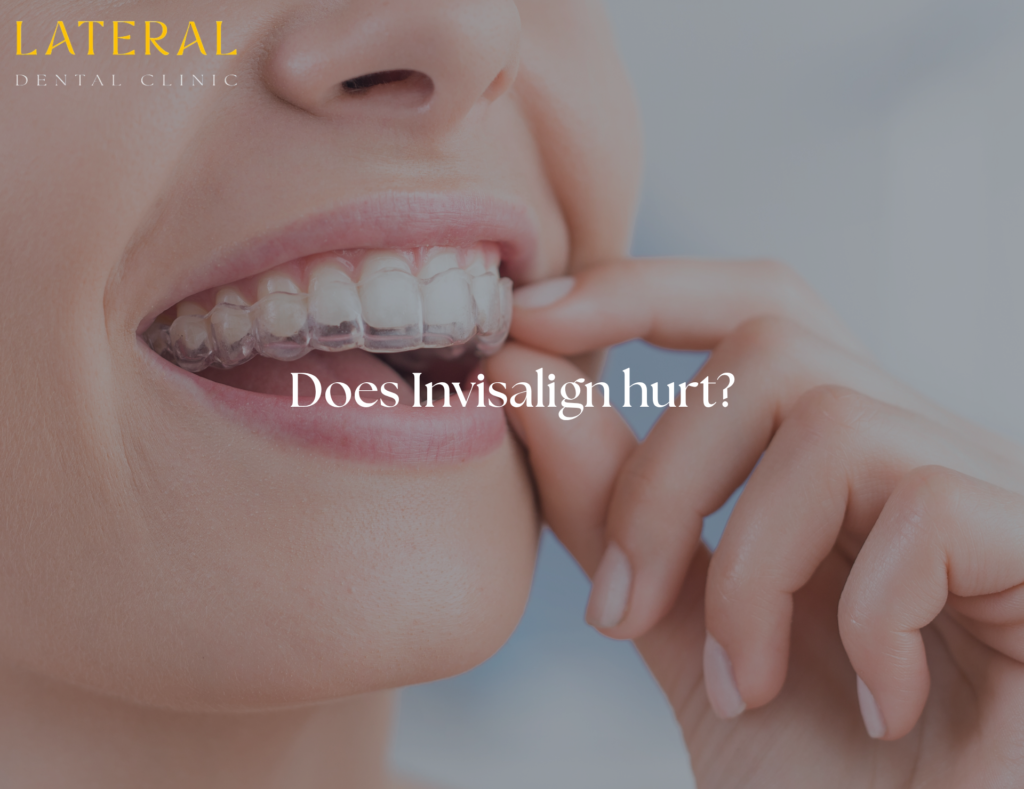
It is one of the first questions almost every patient asks before starting treatment: does Invisalign hurt?
The honest answer is: not in the way most people fear. Invisalign is not painful in the way that a dental injection or a tooth extraction is painful. But it is not entirely comfortable either — and anyone who tells you there is zero discomfort is not being straight with you.
What you will experience during Invisalign treatment is pressure — and in the first few days of wearing each new aligner, that pressure can feel quite intense. Understanding exactly what that sensation is, why it happens, how long it lasts, and what you can do to make it more manageable is the difference between starting treatment with realistic expectations and finding the first week unexpectedly difficult.
At Lateral Dental Clinic in Sheffield, led by Dr Matthew Stephens GDC No. 263989 and Dr Anupa Stephens GDC No. 264031, we have guided many patients through Invisalign treatment and have answered this question hundreds of times. Here is the complete, honest picture.
Why does Invisalign cause discomfort at all?
To understand why Invisalign hurts at certain points during treatment, you need to understand what is actually happening to your teeth.
Each Invisalign aligner is manufactured to be slightly different from the current position of your teeth. This intentional discrepancy — typically a fraction of a millimetre — is what creates the force that moves your teeth. When you first put in a new aligner, it does not fit your teeth exactly: it fits the position your teeth will be in at the end of that aligner stage. The aligner is trying to move your teeth to a new position, and the resistance of the tooth and its supporting structures against that movement is what you feel as pressure and discomfort.
The periodontal ligament — the tough, fibrous tissue that suspends your tooth within its socket — plays a central role in this process. Orthodontic forces compress the periodontal ligament on one side of the tooth and stretch it on the other. This mechanical loading triggers an inflammatory response within the ligament, and it is that inflammation that produces the aching, pressured sensation that patients associate with a new set of aligners.
This is not damage — it is the mechanism of tooth movement. The same process occurs with every type of orthodontic treatment. The difference with Invisalign compared to traditional braces is that the forces are typically lighter and more controlled, which is part of why Invisalign’s discomfort profile is generally milder.
Does Invisalign hurt? What it actually feels like
Patients describe the Invisalign discomfort in fairly consistent terms:
- A feeling of pressure or tightness around the teeth — as though the aligner is gripping
- A dull, persistent ache in one or more teeth, particularly those being most actively moved at that stage
- Tenderness when biting down, making chewing slightly uncomfortable in the first day or two
- Occasional sharp sensitivity on a specific tooth, usually one with an attachment (the tooth-coloured composite buttons used to help specific movements)
- Gum irritation or soreness at the edge of the aligner, particularly in the first week of wearing a new tray
What Invisalign discomfort is not: sharp, shooting pain; severe pain that stops you functioning; pain that lasts throughout the entire aligner stage; or anything that requires prescription painkillers to manage in a typical case.
The overwhelming consensus from patients — and from clinical outcome data — is that Invisalign discomfort is manageable, predictable and temporary.
How long does Invisalign hurt? The timeline in detail
This is the most practically useful question for patients about to start treatment, and the answer follows a fairly consistent pattern. Understanding how long Invisalign takes overall gives important context here — the discomfort pattern repeats throughout treatment, not just at the beginning.
Days 1–3 of each new aligner: The most intense phase
The first 24 to 72 hours after fitting a new aligner are consistently the most uncomfortable part of each aligner stage. This is when the teeth are experiencing the most active movement, the periodontal ligament is under its greatest load, and the inflammatory response within the supporting tissues is at its peak.
During this phase, patients typically describe the pressure as noticeable to moderate. The teeth feel tender to bite on, the aligner feels tight when first inserted, and there is a persistent background ache particularly in the areas of most active movement.
For most patients, this is the phase that catches them off guard if they were not prepared for it. The key thing to know is that this is the worst it gets — and it is temporary.
Days 3–7: Settling and adaptation
By the third day, the acute phase of periodontal ligament inflammation begins to resolve. The aligner starts to feel less tight — which is because the teeth have begun to respond to the force and have moved incrementally towards the target position. The pressure reduces, the tenderness when biting eases, and most patients describe the discomfort as mild to minimal by the end of the first week.
This adaptation window is why many Invisalign protocols advance to the next aligner every one to two weeks — by the time the aligner is fully seating comfortably, it is time for the next one, which starts the cycle again.
The pattern across the full treatment
Invisalign hurts in a cyclical pattern rather than continuously. Each new aligner brings two to three days of noticeable pressure, which then subsides. The transition to a new tray is the uncomfortable moment; the rest of the aligner stage is increasingly comfortable.
Most patients also report that the discomfort associated with each new aligner tends to reduce as treatment progresses. The first few sets of aligners are often the most uncomfortable — partly because the teeth are starting from their most misaligned position and the required movements are sometimes greater, and partly because the patient has not yet developed familiarity with the cycle of sensations.
By mid-treatment, many patients switch to new aligners on a Friday evening specifically — so the worst of the discomfort passes over the weekend when they can manage it more easily at home.
What makes Invisalign discomfort worse?
Understanding the factors that increase discomfort helps you manage the experience more effectively.
Attachments: Invisalign attachments — the small tooth-coloured composite buttons bonded to specific teeth — allow the aligners to apply more precise, complex movements (rotations, extrusions, torque corrections) that plain aligners cannot achieve. Teeth with attachments tend to be more tender during active movement stages because the forces being applied are more targeted and sometimes more significant. This is a clinical necessity for achieving the planned result, but it is worth knowing.
Complex movements: Teeth that are being significantly rotated, extruded or torqued experience more force and therefore more discomfort than teeth being moved horizontally into space. If a particular aligner in your series is addressing a difficult movement, expect slightly more discomfort than usual.
Missing an aligner-wearing session: Invisalign requires a minimum of 20 to 22 hours of wear per day. If aligners are removed for longer than the recommended period — meals, drinks, cleaning — the teeth begin to drift slightly back towards their previous positions. When the aligner is reinserted, it is no longer sitting in the position it was designed to — meaning the force applied feels more acute than if wearing had been consistent. This is one of the practical reasons compliance matters: inconsistent wear not only slows treatment but makes it less comfortable.
Advancing to a new aligner too early: Progressing before the teeth have fully responded to the current aligner means the next set will have more work to do, producing more discomfort. Following your clinical team’s advice on when to advance is important both for comfort and for the accuracy of tooth movement.
How to manage Invisalign discomfort: What actually helps
Ibuprofen
Ibuprofen is the most effective OTC option for Invisalign-related discomfort. As a non-steroidal anti-inflammatory drug, it works by inhibiting the prostaglandin synthesis that drives the inflammatory response in the periodontal ligament — addressing the mechanism of the discomfort rather than just masking the sensation.
Taking 400mg of ibuprofen with food for the first two to three days of each new aligner makes a meaningful difference to the experience, particularly for the first few aligner stages. As treatment progresses and you become more accustomed to the pattern of sensations, most patients find they need it less frequently.
If you cannot take ibuprofen, paracetamol provides analgesic relief though without the anti-inflammatory component.
Switch to new aligners at night
One of the most consistently effective practical strategies: insert each new aligner last thing at night before sleeping. This means the most acute phase of pressure — the first few hours in a new tray — occurs while you are asleep and unaware of it. By the time you wake up the following morning, the initial intensity has reduced considerably.
This approach does not reduce the total discomfort of each aligner stage — but it eliminates the most uncomfortable window from your conscious waking experience, which makes an appreciable difference to how patients experience the overall process.
Stick to soft foods for days 1–3
Biting down on hard or crunchy foods in the first two to three days of a new aligner amplifies the tenderness significantly. During the acute phase, choosing softer foods — anything that requires minimal biting force — makes eating more comfortable and reduces the stimulation of already tender teeth.
This does not mean you are restricted indefinitely. By day three to four, most patients are eating normally without significant discomfort.
Cold water and cold compress
Cold water — either rinsed gently around the mouth or drunk through a straw to reduce direct tooth contact — provides mild temporary numbing through vasoconstriction. Some patients also find a cold compress applied to the outside of the cheek for 10 to 15 minutes provides helpful short-term relief during the most intense phase.
Orthodontic wax for edge irritation
The edges of Invisalign aligners are trimmed to the gum line and generally smooth, but in some cases — particularly near attachments or in areas of thin, sensitive gum tissue — the edge of the tray can cause localised irritation. A small amount of orthodontic wax applied to the edge of the aligner at the irritating spot provides a smooth surface that eliminates the friction.
This is a less common issue with Invisalign than with fixed braces, but it is worth knowing about. If an aligner edge is consistently catching, your clinical team can also smooth it slightly during your next appointment.
Is the discomfort worth it? The honest answer
One of the reasons patients ask does Invisalign hurt is that they are trying to assess whether the discomfort is proportionate to the result. And the honest answer — from both clinical outcomes data and patient experience — is yes, overwhelmingly.
The discomfort associated with Invisalign is:
- Predictable — it follows the same pattern every aligner stage
- Time-limited — it is worst in the first two to three days of each stage and then resolves
- Manageable — standard OTC pain relief and practical adjustments make it very controllable for the vast majority of patients
- Temporary — once treatment is complete, the discomfort stops entirely
What you are left with at the end of treatment — straighter teeth, an improved bite, a more confident smile — lasts far longer than any of the discomfort you experienced along the way.
For further detail on the clinical process, Dr Matthew Stephens and Dr Anupa Stephens have written a detailed explanation of Invisalign treatment that covers the full clinical process, including what happens at each stage of treatment.
When discomfort becomes a reason to call your dentist
The discomfort described throughout this article is the normal, expected experience of Invisalign treatment. There are, however, specific situations where you should contact your clinical team rather than managing at home:
Sharp, persistent pain in a single tooth that does not reduce after three to four days. Normal Invisalign discomfort is an ache affecting the teeth generally, not sharp pain focused on a single tooth that shows no sign of settling. This could indicate an attachment has placed excessive force on a specific tooth, a pre-existing issue with a tooth that the orthodontic movement has aggravated, or a root problem that needs assessment.
Significant gum swelling or a visible change in the gum tissue. Aligners that are not fitting correctly, or that are transmitting forces to the gum rather than the teeth, can cause localised gum irritation beyond the normal scope. If gum tissue looks visibly swollen, red or inflamed in a specific area, have it assessed.
An aligner that does not seat fully despite consistent wear. If an aligner is not tracking — meaning it is not fitting as closely as it should despite being worn for the correct number of hours — advancing to the next aligner in the series will compound the tracking problem. Your clinical team can assess whether refinement aligners are needed.
Any sudden, severe pain that does not feel like the typical Invisalign pressure. Severe, acute dental pain during Invisalign treatment is not a normal side effect and needs assessment.
At Lateral Dental Clinic, patients undergoing Invisalign treatment with Dr Matthew Stephens and Dr Anupa Stephens have access to clinical support throughout their course of treatment — not just at scheduled review appointments.
Invisalign vs braces: Which hurts more?
This is a common comparison patients make, and the evidence points in a fairly consistent direction: Invisalign typically produces less discomfort than traditional fixed braces.
The reasons for this come down to force profile. Traditional fixed braces apply forces via metal wires that are tightened at adjustment appointments — producing acute spikes of force that are then maintained continuously. These adjustment-day spikes can be quite uncomfortable, and the constant presence of the wire means the teeth are under load throughout.
Invisalign delivers forces through the elastic deformation of the aligner material, which is gentler and more distributed. The forces are at their peak when the aligner is first inserted and gradually diminish as the teeth respond — a more physiological loading pattern that the periodontal ligament adapts to more comfortably.
Additionally, traditional braces involve metal brackets and wire ends that cause friction blisters and ulcers on the cheek and lip tissue — a source of significant discomfort that Invisalign does not produce because the aligner surface is smooth.
That said, Invisalign is not without any discomfort — as this entire article has made clear. But for the majority of patients, the comparison favours Invisalign for comfort, particularly once the first few aligner stages have established the pattern.
The bottom line
Does Invisalign hurt? In honest terms: it produces noticeable pressure and aching for the first two to three days of each new aligner, which then settles as the teeth adapt. It is manageable with standard pain relief and practical adjustments. It gets easier as treatment progresses. And it bears no resemblance to the kind of pain associated with dental injections, extractions or other procedures that patients typically fear.
How long does Invisalign hurt? The acute phase of each aligner is two to three days. Outside of those windows, the vast majority of patients are comfortable wearing their aligners and live normally throughout treatment.
If you are considering Invisalign and want to understand whether it is the right treatment for your teeth, what the process involves from start to finish, and what realistic results look like — the starting point is a consultation with an experienced Invisalign provider.
At Lateral Dental Clinic in Sheffield, Dr Matthew Stephens and Dr Anupa Stephens have the clinical depth and patient experience to give you an honest, accurate assessment of what Invisalign can achieve for your specific case — and what the journey to get there actually involves.
Disclaimer
The information in this article is intended for general guidance only and does not constitute personalised dental advice. Individual experiences of Invisalign discomfort vary. Please book a consultation with a qualified dental professional for advice specific to your clinical situation.
Lateral Dental Clinic is a private dental practice in Sheffield, led by Dr Matthew Stephens GDC No. 263989 and Dr Anupa Stephens GDC No. 264031. We offer Invisalign treatment in Sheffield, composite bonding, porcelain veneers, teeth whitening, dental crowns, smile makeovers, dental sedation and general dentistry. For a full explanation of the Invisalign process, visit our Invisalign guide or find out how long Invisalign takes.
Questions our patients ask about Invisalign discomfort
For most patients, no. Invisalign typically produces less discomfort than traditional fixed braces. The forces applied by aligners are lighter and more distributed than the acute spikes produced by wire-tightening at brace adjustment appointments. Invisalign also does not cause the friction blisters and cheek ulcers associated with metal brackets and wire ends. This does not mean Invisalign is pain-free — but the discomfort profile is generally milder and more predictable.
When Invisalign hurts most acutely is in the first two to three days of wearing each new aligner. After this initial phase, the discomfort reduces significantly as the teeth respond to the force and the aligner begins to seat more closely. The pattern repeats with each new aligner throughout treatment. For how long Invisalign takes in total, this depends on case complexity — but the discomfort cycle is consistent regardless of treatment duration.
Mild tenderness focused on specific teeth is normal during active Invisalign movement — particularly in teeth with attachments or teeth undergoing complex movements such as rotation. However, sharp, persistent pain in a single tooth that does not reduce after three to four days of wearing a new aligner is worth discussing with your clinical team at Lateral Dental Clinic, as it may indicate a tracking issue or a pre-existing tooth problem that needs assessment.
Ibuprofen is the most effective OTC option because it addresses the inflammatory component of the periodontal ligament response that drives Invisalign discomfort — not just the pain signal itself. Take 400mg with food for the first two to three days of each new aligner, particularly for the earlier aligner stages. Inserting new aligners last thing at night so the most intense phase passes during sleep is a practical strategy that many patients find makes the experience significantly more manageable. For more detail on what to expect throughout treatment, our Invisalign guide from a Sheffield dentist covers the process in full.
Invisalign hurts in a cyclical pattern — discomfort with each new aligner, then settling — rather than continuously throughout treatment. The first few aligner stages are often the most uncomfortable because the teeth are starting from their most misaligned position and the required movements can be more significant. As treatment progresses, most patients find the discomfort associated with each new aligner reduces. By mid-to-late treatment, many patients describe new aligner changes as mildly noticeable rather than genuinely uncomfortable. The process from start to finish is explained in detail by Dr Matthew Stephens and Dr Anupa Stephens at Lateral Dental Clinic.