Dental Phobia
What it really is, why it keeps so many people away, and what has genuinely changed
There is a particular kind of trap that dental phobia creates. You know you need to go. You can feel or see that something is wrong. The thought of making the call sends a wave of anxiety through you, so you put it off. And as the weeks turn into months, the anxiety about what might need treating compounds the original fear, until the whole thing feels completely impossible to approach.
If this is you, the first thing worth saying is: you are not the only one. Research in the UK consistently puts significant dental anxiety at around one in three adults, with true dental phobia, defined as a persistent, irrational fear producing significant avoidance, affecting an estimated one in ten. That is millions of people in exactly the same position.
The second thing worth saying is that the dental experience that created the fear, for most people, does not reflect what dental care looks like today. Techniques, materials, anaesthetics and the understanding of what anxious and nervous patients need from a clinical team have all changed considerably. The appointment that traumatised someone twenty years ago is not the appointment they would have now.
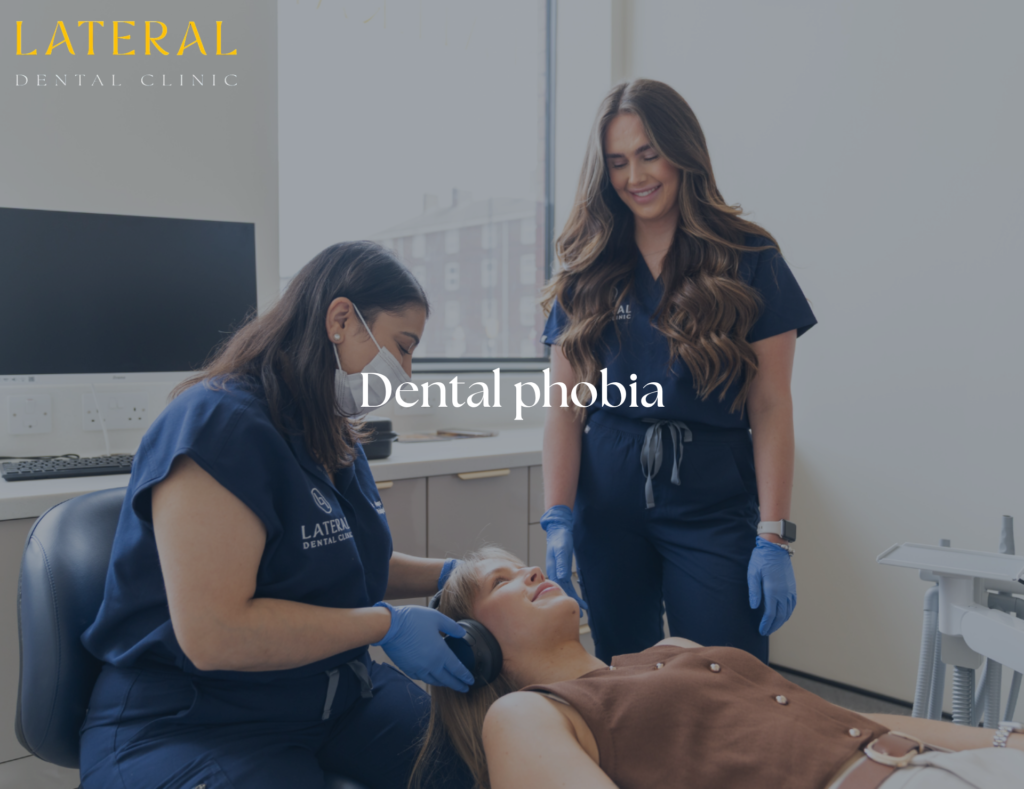
At Lateral Dental Clinic in Sheffield, led by Dr Matthew Stephens GDC No. 263989 and Dr Anupa Stephens GDC No. 264031, nervous patients and anxious patients are a significant part of the practice. We are familiar with the full range of presentations, from patients who are simply apprehensive about routine care to those who have not seen a dentist for a decade or more because the fear felt insurmountable. This article explains what we know about dental phobia and what actually helps.
What makes dental phobia different from ordinary nervousness
Almost everyone feels some degree of nervousness before a dental appointment. That is a normal physiological response to an unfamiliar, slightly vulnerable situation. Dental phobia is categorically different in the way it affects behaviour.
The clinical distinction is avoidance. A person who is nervous but still attends appointments, sits through treatment with some discomfort, and leaves with the work done, has dental anxiety. A person whose fear is severe enough that they cannot make themselves attend at all, or who panics during treatment to the point where it cannot proceed, has crossed into phobia territory.
Phobia involves a disproportionate and sustained fear response that is not modulated by rational reassurance. Telling someone with dental phobia that “it will not hurt” or “it is just a check-up” does not meaningfully reduce the fear, because the fear is not based on a rational risk assessment. It is a conditioned response, rooted in past experience or a generalised anxiety pattern, and it operates through the same neurological pathways as all phobic responses: a threat-detection system that fires even when the conscious mind knows the threat is not proportionate.
Understanding this is important, both for the person experiencing it and for the clinicians managing it, because it changes what kind of intervention actually helps.
Where dental phobia comes from
Fear of the dentist is almost never random. It has an origin, and knowing the origin often points toward what will help most.
A previous painful or distressing experience
The most common root. A childhood procedure that was not adequately anaesthetised. A dentist who did not respond appropriately when the patient indicated pain. Being held down or not listened to. Being told off for the state of the teeth. Any of these creates a memory that the threat-detection system files as a genuine danger signal, and which the brain retrieves every time a dental appointment is contemplated.
The neuroscience here is well established: the amygdala encodes emotional memories differently from factual ones, with fear conditioning happening rapidly and persisting strongly. A single deeply unpleasant dental experience can create a fear response that persists for decades, even when the person intellectually knows that dentistry has changed and that their current clinician is not the same person who caused the original distress.
Loss of control and vulnerability
For many anxious patients, the fear is not specifically about pain. It is about the experience of being in a reclined position, unable to speak, with instruments in their mouth and no ability to stop what is happening. This is a vulnerability that triggers threat responses in some people regardless of the actual level of risk.
This type of fear responds particularly well to strategies that restore the sense of control: a pre-agreed stop signal, narration of every step before it happens, being able to sit upright at any point, and knowing that stopping is always an option.
Fear of a specific component
Some patients who describe themselves as scared of the dentist are actually specifically scared of one element: the injection, the drill sound, the smell of dental materials, or the gagging sensation. These specific phobias can be severe while leaving the rest of the appointment manageable.
Needle phobia (trypanophobia) is particularly relevant in dentistry because local anaesthetic administration is the gateway to most treatment. A patient who cannot tolerate the injection cannot proceed with the treatment that requires it. For these patients, specific strategies including topical anaesthetic applied before the injection, slow and deliberate technique, distraction methods, and in some cases dental sedation that reduces the awareness of the injection are clinically useful.
Generalised anxiety and health anxiety
For a proportion of people who are scared of dentists, the dental fear is not isolated: it exists alongside generalised anxiety disorder, health anxiety, OCD, or other psychological conditions that make the dental setting acutely activating. These patients benefit from a clinical team that understands anxiety broadly, not just in its dental manifestation.
What the avoidance cycle does to dental health
This section exists not to create further anxiety, but because understanding the clinical consequences of avoidance is genuinely useful information for patients deciding whether to seek help.
The progression is consistent. A small cavity that would have been a minor filling becomes, over two or three years of avoidance, a larger cavity reaching closer to the nerve. Eventually it begins to cause pain. The pain brings the patient in for the first time in years, often as an emergency, in an already elevated state of anxiety, needing the more extensive treatment that their fear was trying to avoid. The emergency experience reinforces the fear. The cycle continues.
Gum disease follows an almost identical pattern: entirely painless and entirely reversible in its early stages, progressing silently over years of missed appointments to the bone-destroying periodontitis that requires significantly more complex treatment. The absence of pain is specifically what allows it to progress undetected.
Patients who have avoided dental care because of fear of the dentist typically come in needing more treatment than they would have needed years earlier, and in a context where anxiety is higher because the situation is more acute. This is the real cost of dental phobia.
What makes a genuine difference for anxious and nervous patients
Communication before the appointment
This is the single most impactful variable. Nervous patients who contact the practice in advance, explain their anxiety and what has been difficult in the past, arrive at a different kind of appointment from those who say nothing and brace silently. The team can prepare: a longer appointment, a specific clinician who is experienced with anxious patients, topical anaesthetic ready before any injection, a calm and unhurried welcome.
At Lateral Dental Clinic, patients are actively encouraged to share their concerns before the appointment, not on arrival. This gives the team time to adapt the environment and the plan to what the patient actually needs.
The pre-agreed stop signal
One of the most reliably effective techniques for anxious patients in the chair is establishing a clear stop signal before anything begins. Typically a raised hand. A signal that means: stop immediately, instruments out, we wait. No questions, no gentle cajoling to continue, no “just a little longer.”
The clinical team honours this unconditionally. What this does is restore the sense of control that is absent for so many people who are scared of the dentist: the knowledge that stopping is genuinely always possible, and that the patient is not at the mercy of the procedure, transforms the experience for many people even before anything clinical has happened.
Narration and transparency
Explaining exactly what is about to happen before doing it, every time, throughout the appointment. Not a one-time briefing at the start, but a running commentary. “I am going to place a cotton wool roll on the left side. Now I am going to apply the numbing gel, which takes about a minute. Now you will feel me pressing on the gum, this is the start of the injection, and I am going to go very slowly.”
This converts unfamiliar into familiar. And familiar is dramatically less activating than unknown.
Working at the patient’s pace
For anxious patients with significant dental phobia, the most productive first appointment is sometimes one where nothing clinical happens at all. A conversation. A look at the teeth with a mirror. Meeting the clinician and the setting. Leaving with a single positive reference point for what attending the practice feels like.
This is slower than a conventional appointment structure. It is also considerably more effective at producing lasting engagement with dental care, because the patient leaves having had a manageable experience rather than having been pushed through an experience that was not yet manageable.
The first appointment is a deposit in a trust account, not a claim against one.
Dental sedation for those who need more support
For patients whose fear of dentist is severe enough that the above strategies are not sufficient, or who have tried before without success, conscious dental sedation provides a clinical pathway to receiving treatment that would otherwise remain impossible.
Sedation at a dental practice is not general anaesthetic. It is conscious sedation: the patient remains awake and can respond to instruction, but is deeply relaxed and in most cases has little to no memory of the appointment afterwards. The most commonly used agent for IV sedation is midazolam, a benzodiazepine that produces rapid anxiolysis and pronounced anterograde amnesia.
For patients who have been scared of dentists for years and have accumulated a significant treatment need, dental sedation allows multiple procedures to be completed in one or two appointments while the patient is comfortable and relaxed, rather than requiring many individual appointments of escalating difficulty.
The procedures most commonly feared, and what sedation makes possible
Root canal treatment
Root canal treatment is probably the most feared procedure in dentistry, and its reputation is significantly worse than the modern reality warrants. Performed under local anaesthetic with adequate technique, root canal treatment involves no more discomfort during the procedure than any other restorative treatment. What patients feel is pressure and movement, not pain.
For patients who remain too anxious to tolerate root canal treatment despite reassurance, dental sedation allows the procedure to proceed while the patient is relaxed and largely unaware. The treatment is identical: the local anaesthetic still works, the procedure still takes the same time. The difference is the patient’s experience of it.
Dental crowns
Dental crowns involve tooth preparation that can be lengthy and, for patients with significant anxiety, feel overwhelming even with adequate anaesthesia. The sound of the drill, the pressure of the preparation, the time in the chair all contribute. A crown appointment under dental sedation is, for many patients, the first time they have been able to receive this type of treatment without stopping or walking out.
A full dental check-up
For some patients with severe dental phobia, even a dental check-up feels insurmountable. The examination, the probe, the X-rays, the conversation about what has been found: all of these can be profoundly activating for patients with significant avoidance. Dental sedation can be used for a comprehensive assessment appointment, allowing the patient to tolerate a thorough examination and for the clinical team to establish exactly what needs treating, so a plan can be made.
Building a relationship over time
Dental phobia does not typically resolve in a single appointment. What happens, with consistent, supportive care and a practice that genuinely accommodates anxiety, is a gradual normalisation of the dental experience.
Patients who begin with sedation for every appointment sometimes find, after one or two such appointments, that they are able to attend subsequent ones without sedation. The experience under sedation was manageable. The team were kind and did not push. The treatment was completed without the feared catastrophe. And with that new reference point, the fear begins to reduce.
This is not guaranteed. Some patients prefer to use sedation indefinitely, and that is a completely valid and clinically manageable choice. The option remains available regardless of how the treatment journey progresses. The general dentistry services at Lateral Dental Clinic are structured to be accessible to patients wherever they are on that journey, including those who need routine care delivered at a pace and in a manner that takes their anxiety seriously.
In conclusion
Dental phobia is real, it is common, and it does not make someone unusual or difficult. It makes them a patient who needs a different kind of care from someone who is comfortable with dental treatment. That care exists.
The strategies that help, from pre-appointment communication to stop signals, narration, working at the patient’s pace and dental sedation for those who need it, are all available at Lateral Dental Clinic in Sheffield.
For patients who are scared of the dentist and have been for years: the first step is a phone call or a message. Explain what is difficult, what has happened in the past, what would make a first appointment feel possible. The team will build from there.
That first step does not require you to be ready for treatment. It requires you to tell us where you are. Everything else follows from that.
Disclaimer
The information in this article is intended for general educational guidance only and does not constitute personalised dental or medical advice. If you are experiencing significant dental anxiety or dental phobia, please contact a qualified dental or healthcare professional for support tailored to your specific situation.
Lateral Dental Clinic is a private dental practice in Sheffield, led by Dr Matthew Stephens GDC No. 263989 and Dr Anupa Stephens GDC No. 264031. We offer dental sedation for nervous and anxious patients, dental check-ups, root canal treatment, dental crowns, general dentistry, Invisalign, composite bonding, porcelain veneers, teeth whitening and smile makeovers.
Frequently asked questions
The most important thing to know is that there will be no judgement about the gap in your care. What the clinical team will want to understand is what you have found difficult in the past, what specifically causes your anxiety, and what would make the first appointment manageable. There is no obligation to have treatment at the first visit: for many patients with significant dental phobia, the initial appointment is purely a conversation and perhaps a look with a mirror, with no clinical work planned. The goal of the first appointment is a single positive experience in the practice, building enough trust to come back.
Yes. Dental sedation is not reserved for surgical or complex treatment. For patients whose anxiety is severe enough that even a dental check-up feels impossible without it, sedation can be used to allow a comprehensive examination. This is clinically useful because it gives the team a full picture of what needs treating, so a realistic plan can be made, without the patient having to push through a level of distress that makes cooperation impossible.
Yes, and this is one of the most frequently managed specific fears. Topical anaesthetic gel applied to the gum for 60 to 90 seconds before the injection significantly reduces the sensation of the needle penetrating the surface tissue. A slow, deliberate injection technique using a fine gauge needle and administered over 30 to 60 seconds is considerably more comfortable than a fast one. Distraction techniques and counting can help. For patients whose needle phobia is severe enough that none of these provide sufficient relief, IV sedation, which is itself delivered via a small needle, can be preceded by topical anaesthetic cream applied to the skin, reducing even that sensation.
Correct: you cannot drive for the remainder of the day after IV sedation with midazolam. You will need to arrange for a responsible adult to accompany you to the appointment and take you home, and you should not drive, operate machinery, drink alcohol or make significant decisions for the rest of that day. The sedation effect diminishes over the following hours and most patients feel back to normal by the following morning. Nitrous oxide (inhalation sedation) has a much faster offset and many patients can drive within 30 minutes of completion, but this is assessed individually.
It is important to understand that consent and control are maintained throughout a sedation appointment. You can stop at any time. The pre-agreed stop signal applies regardless of your sedation state, and the team will respond immediately if you indicate distress. Under IV sedation, the level is titrated to achieve adequate relaxation, and if a patient is showing signs of distress the level can be adjusted. For the most severe presentations of dental phobia, the clinical team will discuss the most appropriate level of sedation support during the pre-sedation consultation, so the appointment is planned around what you actually need.